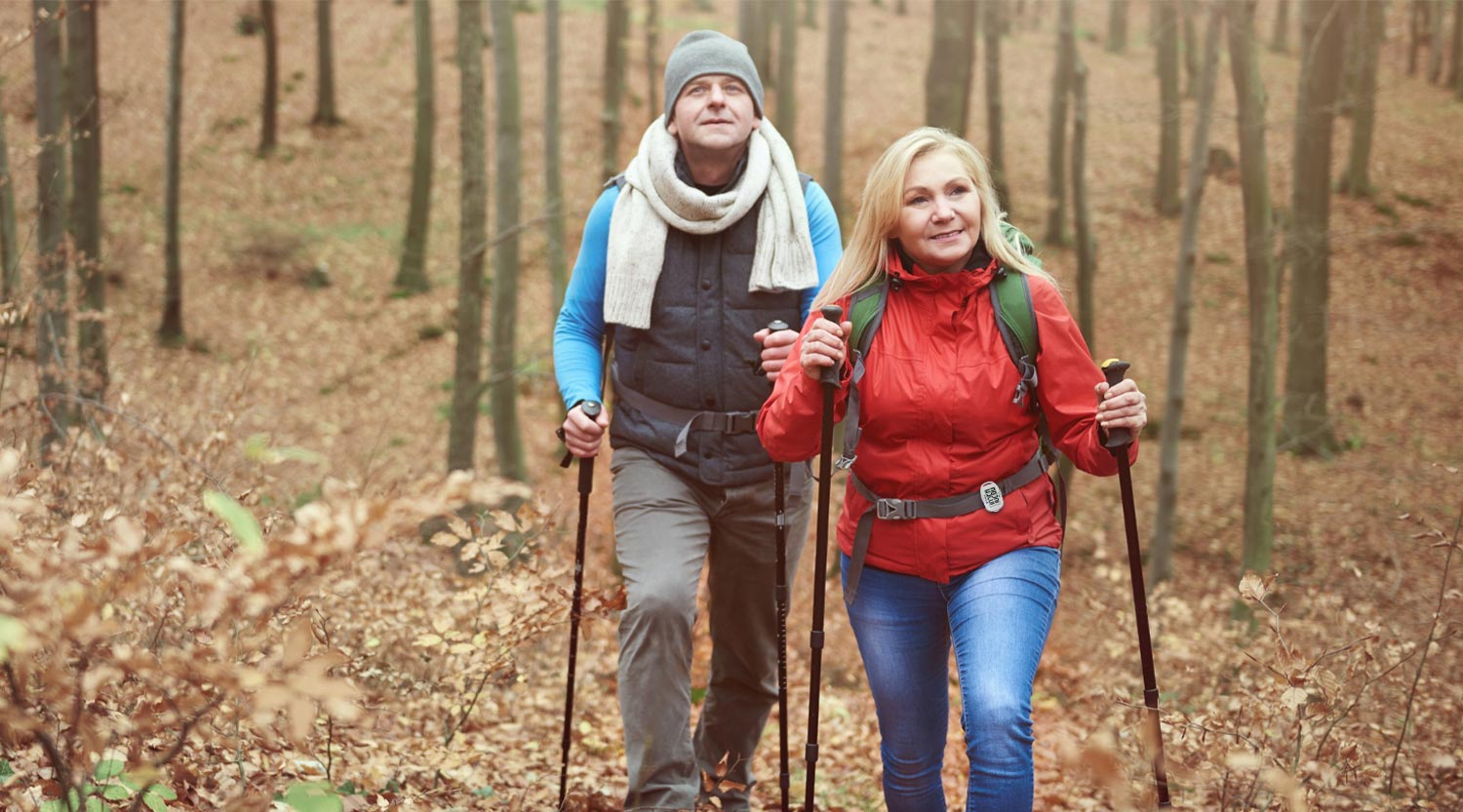
I'll be honest - the first time I saw someone Nordic walking through a park, I assumed they'd forgotten to go skiing. Poles, purposeful stride, the whole thing. It looked slightly unhinged for a Tuesday morning in a city.
Turns out they were onto something. Nordic walking started in Finland in the 1990s when cross-country skiers needed a way to train through the summer. No snow, no problem - they just took their poles to forest paths & walked hard. Finnish fitness coaches started teaching it. Researchers started measuring it. And what they found has been quietly making regular walking look like it's been holding back.
The Mistake Almost Everyone Makes on Day One
Nordic walking & hiking with poles look the same from a distance. They're not. The difference is one movement: where the pole plants.
Hikers plant their poles in front of them - it's a stability thing, weight distribution on rough ground. Nordic walkers plant behind the hip & push through. That push is what changes everything. It pulls your arms, shoulders, lats & core into the movement in a way that regular walking simply doesn't reach.
Get that technique right & you're working 80 to 90% of your body's muscles at once, compared to roughly 40% in a normal walk. The calorie burn runs 18 to 22% higher at the same pace - not because you're working harder, but because more of your body is involved. Heart rate goes up. Perceived effort doesn't. That gap is where Nordic walking earns its reputation.
What the Research Actually Shows
Multiple peer-reviewed studies - including a systematic review in the American Journal of Preventive Medicine & data from the Cooper Institute - have compared Nordic walking directly with regular brisk walking. Here's what changes:
| What Changes | Regular Brisk Walking | Nordic Walking |
|---|---|---|
|
Muscles used |
Mainly legs & core |
80 -90% of body - arms, shoulders & back fully engaged |
|
Calorie burn (same duration) |
Baseline |
18 -22% more - consistent across multiple studies |
|
Walking speed |
Your usual pace |
Up to 25% faster - poles create forward drive |
|
Joint load |
All weight through two legs |
Distributed across four limbs - less strain on knees & hips |

How to Actually Get Started
Here's something the fitness world doesn't often say enough: good timing matters. A long weekend - no commute, open parks, nowhere to rush - is genuinely the best time to try something that looks slightly odd in public. The technique clicks faster when you're not clock-watching.
Start here, before you take a single step:
-
Get your pole length right. Multiply your height in centimetres by 0.68, then round to the nearest 5cm. Hold the pole with the tip resting on the floor - your forearm should sit roughly parallel to the ground. Wrong length, wrong posture, wrong technique from the start.
-
Start on flat ground. Ignore hills for the first two sessions. The arm-push feels strange until it doesn't - & that usually takes two or three outings, not two or three hours.
Weeks 1 - 2:
Three sessions of 20 minutes each. Every one of them focused on the same thing: pushing through the pole behind your hip rather than leaning on it. Track your steps - Nordic walks typically run 15 to 20% longer in distance for the same duration, so you should start seeing that in the numbers.

Week 3 onwards:
Extend sessions to 30 -40 minutes & introduce gentle inclines. Uphill is actually where Nordic walking really separates itself - the poles take a meaningful share of the load & perceived effort stays surprisingly low even as the terrain gets harder.
A Few Things Worth Knowing Before You Head Out
These aren't warnings - they're the things that make the difference between someone who tries Nordic walking once & someone who keeps going.
Don't grip the poles.
The glove-strap design on Nordic poles exists for exactly this reason. Your hand is supposed to open on the back swing & close again naturally. If you grip, you kill the upper-body engagement & miss the whole point. Loose hands, deliberate push.
Shoulders down, not up.
New Nordic walkers almost always hunch. Keep your chest open & your shoulders relaxed - the poles are doing the work, not your traps.
You will look slightly odd for about one session.
By session two, you stop noticing. By session four, you're mildly annoyed at everyone walking past you without poles.
Track your steps.
Nordic walking covers more ground per session - a pedometer shows you whether your longer stride & higher pace are actually translating to more daily steps, which they should. It's a small thing that makes the progress feel real.
Nordic Poles vs. Trekking Poles - This Distinction Matters
They are not the same thing. Nordic poles use a glove strap so your hand can push through & release naturally. Trekking poles have a wrist loop & plant in front for stability. Using trekking poles 'Nordic-style' doesn't produce the right mechanics - the propulsion never works. Wrong pole, wrong result.
Who Gets the Most Out of This
Broadly, anyone who walks regularly & wants more from the same time investment. But two groups see specific, meaningful benefits worth calling out:
-
People with knee or hip pain. Weight distributed across four limbs takes a real load off affected joints. This isn't marketing copy - British Nordic Walking has an NHS social prescribing connection in several UK regions specifically because of the joint-load research.
-
People who want weight loss results without more time. The 18 -22% extra calorie burn at the same duration adds up across a week. The exercise equation improves without the session getting longer.

FAQ's
-
Do I need lessons, or can I just pick it up myself?
Most people get the basic technique in one session - a short class or a YouTube tutorial from British Nordic Walking both work. The arm-push feels strange for the first ten minutes, then it clicks. Formal lessons speed things up but aren't essential.
-
Will this actually help me lose weight?
More than regular walking, yes. The extra calorie burn is real & documented. That said, weight loss still comes down to total energy balance - Nordic walking improves the exercise side of it without adding extra time to your day.
-
Can I do this with bad knees?
It's one of the better options for it. Distributing weight across four limbs reduces knee & hip load compared to walking unaided. NHS social prescribing programmes in some UK regions use Nordic walking specifically for joint conditions.
-
What's the actual difference between Nordic & trekking poles?
Technique & strap design. Nordic poles use a glove strap so your hand can push through & release on the back swing. Trekking poles have a wrist loop & plant in front for stability. Using trekking poles for Nordic walking doesn't produce the right propulsion - it just looks the same.
-
How do I know if I'm covering more ground than a regular walk?
A pedometer is the simplest check. Nordic walking typically produces more steps per session at the same duration because your pace increases with the pole drive. The 3DFitBud Simple Step Counter clips to your waistband, counts every step through both poles-in & poles-out sessions & works without a phone or charging. It just counts.
More Steps. Same Walk. Check Whether It's Showing Up.
Nordic walking should produce more steps, more distance & a higher heart rate than your usual route - at the same duration, with no added time commitment. The only way to know if it actually is? Check the number.The 3DFitBud Simple Step Counter clips to your waistband, tracks every step through poles-in & poles-out sessions alike & doesn't need your phone, an app, or charging. It counts steps. That's the job - & it does it reliably.
Shop the 3DFitBud Now