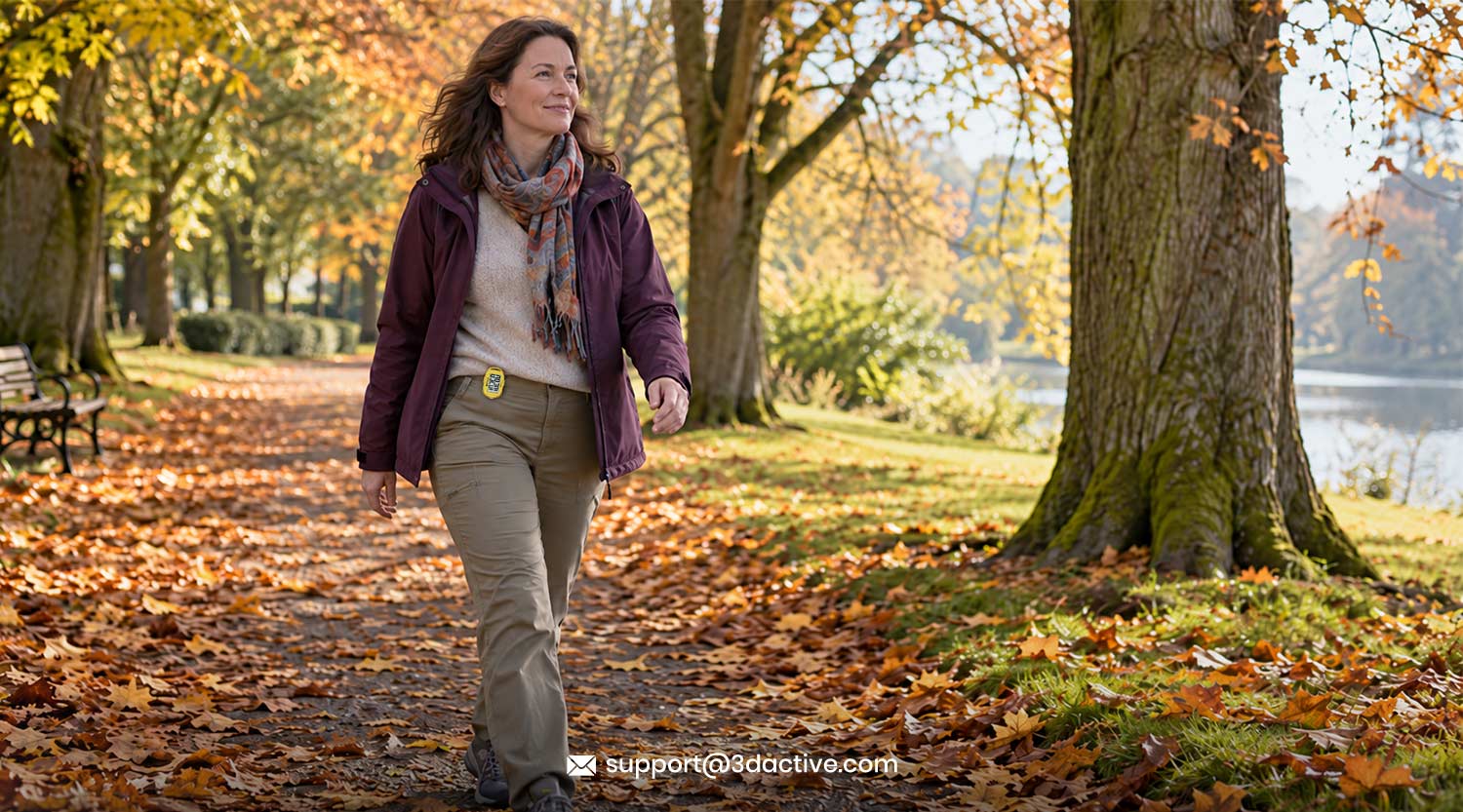
Ten thousand steps. It’s been on your watch since the day you got it, it’s the default in every app and most of us never asked who decided on it. You know the drill. Half nine at night, you’re on 9,600, off you go round the kitchen to finish the job.
No doctor picked that number. It came from a sixties advert for a pedometer. That’s it.
Where 10,000 Came From
Just before the 1964 Tokyo Olympics, a Japanese firm called Yamasa brought out one of the first wearable pedometers. They called it the Manpo-kei, which means “10,000 steps meter.” Why ten thousand? It had a ring to it, people remembered it and the Japanese character for 10,000 looks a bit like a person walking. That was the thinking.

I-Min Lee, a Harvard epidemiologist, has spent years on steps and mortality. She went digging for the study behind the number and found there wasn’t one. Nobody had tested 10,000 when the thing went on sale. She’s since called it a marketing tool, a line written to shift a gadget. Sixty years later we still treat it like a prescription.
So How Many Do You Really Need?
The biggest piece of work on this pooled 15 studies and almost 50,000 adults and it ran in The Lancet Public Health in 2022. The more you walk, the lower your risk of dying early, right up until the line goes flat. Where it goes flat depends on your age.

Over 60, it flattens around 6,000 to 8,000 steps. Under 60, so most of us, it flattens at 8,000 to 10,000 steps a day. So 10,000 isn’t nonsense. It’s the top end, not a floor you keep sliding under. Hit 8,000 on a normal day and you’ve got nearly all of it. In another study of middle-aged adults, getting past 7,000 a day went with a 50 to 70% lower risk of dying early.
None of this is me telling you to do less. It’s that nothing special happens on step 10,000. Go from 8,000 to 10,000 and you’ll hardly notice. Go from 3,000 to 8,000 and you’ve changed something.
Why the Round Number Trips You Up
One number, every day, pass or fail. That’s a brilliant way to kill a habit. It’s gone two, you’re miles off, the day’s a write-off, so you stop trying.
What actually counts is showing up across the week. Five days on 8,000 will do more for you than a big 12,000 on Sunday and nothing after it.
A Smarter Way to Read the Number
|
The 10,000 Rule Says |
What the Research Says |
|---|---|
|
10,000 a day or you’ve failed |
8,000–10,000 is the under-60 plateau. A range, not a pass mark |
|
More is always better |
It flattens. Past the plateau there’s little to gain |
|
One big daily total is the goal |
The week matters more than any one day |
|
You’ve got to walk briskly |
Total steps did the work. Pace added nothing |
That bottom row surprises people. Once total steps were accounted for, how fast you walked made no real difference. No need to march. Just go.
Where Your Phone Lets You Down
Loads of your steps never get counted. Phone’s on the desk, in your bag, face down in a meeting. Every trip to the kettle vanishes and it’s those little walks that take you from 5,000 to 8,000. Desk job? Our steps working from home guide has more on that.
FAQs
-
So is 10,000 steps a day bad advice?
Not bad. Just made up. It was a product name first. For under-60s it’s a sensible ceiling. The problem is treating it as a minimum and feeling rubbish the second you miss.
-
What’s the actual minimum for health benefits?
No clean cut-off, but it kicks in well before 10,000. Past 7,000 a day and early death risk drops a lot. Under 60 it keeps improving to about 8,000 to 10,000, then levels off.
-
I only do about 5,000. Am I wasting my time?
Not a chance. The big wins come from getting off the bottom, so 5,000 to 7,000 buys you more per step than 8,000 to 10,000 will.
-
Does walking faster count for more?
By itself, no. Once researchers counted total steps, pace stopped mattering. A slow wander round the block still counts.
-
Do the steps have to be in one go?
No. They pile up all day. Walk to the station, nip to the shop, pace about on a call, it all goes in.
Stop Chasing a Number an Ad Team Picked in 1964
The 3DFitBud Simple Step Counter keeps it simple: Clips on your waistband and counts every step, all day Picks up the short trips your phone misses No phone, no app, no sign-up, no charging One clear number and the target’s yours
Set a goal you can stick to and let the 3DFitBud count.
Grab your 3DFitBud Now